Will the office of tomorrow be a low-carbon hotel product? Highlights of the round table hosted by Comet at MIPIM 2024: uses, services and profitability.
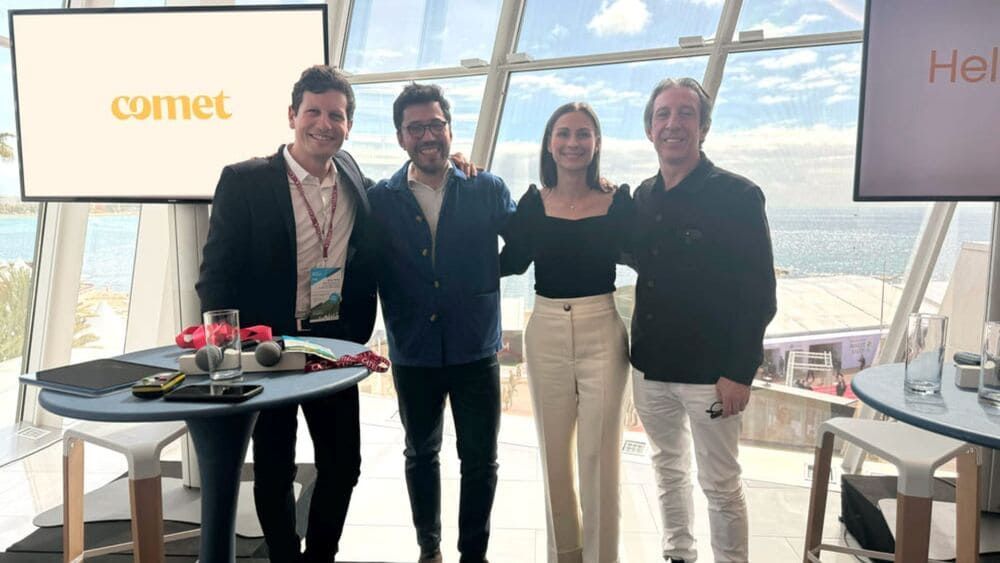
For MIPIM 2024, Comet hosted a round table on a subject close to our hearts.
“The office of tomorrow: a low-carbon hotel product?”
To lead this round table, we were treated to an XXL cast:
- Laurence Desmazières - managing partner at Icawood
- Walid Goudiard - ex-JLL and founder of the company Sarment
- Philippe Chiambaretta - founding architect of PCA-STREAM
- Matthieu Nicoletti - chief Development Officer & Belgium GM at Comet
Here is a short summary of the topics covered during the round table
Our office is undergoing a full metamorphosis. Seen as a place to live by some and as a source of income by others, this real estate asset sits at the heart of the societal, environmental and economic changes stirring up our ecosystem.
The growing demand for flexibility, the emergence of hybrid working practices, the search for financial security and energy efficiency... major macro and structural changes require a reorganisation of the office and a better fit with users' needs as well as with owners' financial imperatives.
Why not draw our inspiration from the revolution the hotel industry has been through to take on these challenges? What if low-carbon-footprint requirements became an opportunity for everyone? What if diversifying the office offering benefited users and owners alike?
The twin crisis of use and of values, a decisive change for the future
The future of office real estate is marked by a twin crisis of use and of values. This crisis stems not only from a drop in demand for square metres but also from a supply crisis, since supply no longer meets users' day-to-day needs. In France, the market is mainly concentrated around the Paris region, where office real estate, having become obsolete, no longer satisfies the new requirements of companies and employees. The rise of remote working, the increase in interest rates, environmental concerns and the organisational changes accelerated by COVID-19 have amplified a growing disaffection with traditional offices.
Indeed, the gap between the way office spaces are perceived and used and users' real needs is glaring. However, hope is gradually beginning to take shape: faced with this observation, companies are slowly starting to recognise the need to transform their offices into attractive spaces offering employees a positive and distinctive experience, thereby encouraging them to choose to come to the office rather than being obliged to.
In competition with other workspaces such as the home or third places, the office sets itself apart by becoming a place of relationships, organised and designed to encourage collaboration, meetings and socialising. It is no longer limited to a production space.
The “hotel-office” and low carbon, an answer for owners and users
To be attractive, the office of tomorrow combines the intimate and the collective, as much in the choice of materials as in the layout of its spaces or its portfolio of associated services. It is becoming essential to create spaces allowing both privacy and socialising, all in an energising atmosphere.
The appearance of a new asset class, “hotel-offices”, sketches out a promising solution. These integrate not only the flexibility of the hotel model, offering short- or long-stay options, but also the sector's service approach, in order to enhance the user experience and make these spaces an element of distinction, or even a talent retention tool.
The key to the success of the office of tomorrow will then lie in the practice of “yield management”, by managing the profitability of every square metre in a rigorous and flexible way. By combining long-stay (lease), medium-stay (coworking) or short-stay (meetings & events) models, these new real estate assets ensure genuine success on both counts. Not only do they enrich and loosen up the offering made to companies and their employees, but they also diversify the income of property owners and thus help to de-risk the financial management of office assets. On these issues of diversifying models and integrating a portfolio of services, operators such as Comet naturally position themselves as ideal partners, true development duos and new-generation asset managers.
Building and enhancing the “hotel-office”: the advantages of the opco-propco pairing
The “hotel-office” concept focuses on the user experience and on owners' profitability needs by developing an enriched base of services and a real guarantee of flexibility. To make it happen while drawing on the available expertise, it is now obvious that operators and owners must come together from the very genesis of projects. The former will bring their knowledge of running services and of short- and medium-term rental models, while the latter will share and apply their expertise in financial management and long-term profitability. Of course, this tandem will benefit from involving users and architects in the conversation, in order to stay ever closer to the reality of use and thus adapt spaces to real needs.
The office of tomorrow therefore depends directly on close collaboration between the sector's various professionals, in particular between property owners and the most innovative operators. This tandem is vital to keep up with the constant changes experienced by companies and employees while guaranteeing solid, de-risked profitability for spaces. By combining traditional players' expertise in property management with the new services introduced by operators, creating workspaces that are more flexible, better serviced and focused on the user experience will be both easier and financially attractive.