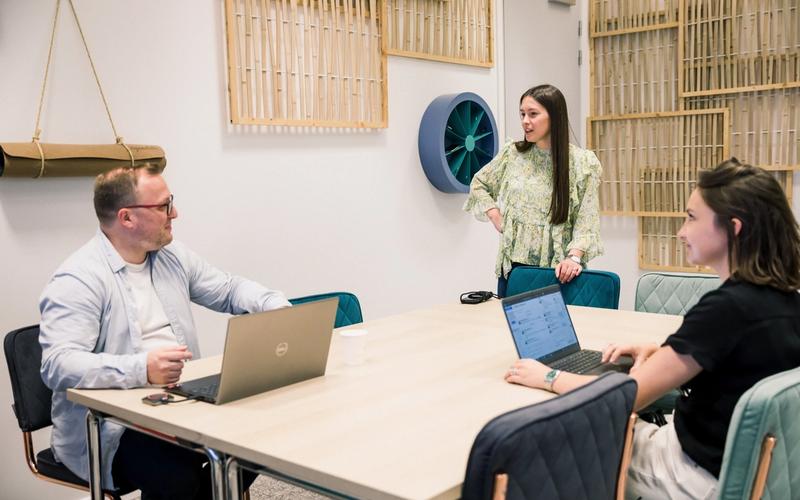

The hotel-office: a flexible, serviced office that you pay for according to your needs.
At a time when ways of working are changing fast, the office real estate sector absolutely must adapt. The valuation crisis we are going through highlights two major issues: the transformation of uses and the fall in the occupancy rate. This unprecedented context calls for innovative solutions to bring new value to workspaces. Between flexibility, modularity and the activation of services, discover how offices can become dynamic and efficient social hubs.
Only ten years or so ago, companies were systematically chained to 3/6/9 leases, which led to a costly under-use or a painful over-use of office space.
A CRISIS OF USES…
Observed for several quarters now, office real estate is going through a deep transformation, accentuated by the valuation crisis. Two major elements underpin it: a crisis of uses and a crisis of occupancy.
First, uses. Historically, the “office” referred to the physical place you went to in order to work from 9am to 6pm. Today, with the massive adoption of remote working by nearly 65% of French workers (source: TelusUnique 2024), that conception is changing.
Employees carry out their production tasks at home. At the office, on the contrary, they focus on socialising and collaboration activities. To do so, they no longer need simple “open spaces”, filled with individual desks, but a “social hub”, a dynamic hive where encounters and interactions take pride of place.
The “bureau” finally seems more and more badly named in our beautiful French language. Originally designating a piece of furniture, the term is today a long way from this place that is more strategic than ever for our companies.
…TOWARDS A CRISIS OF OCCUPANCY
Office occupancy is also experiencing a significant decline.
In the Île-de-France region, company move-ins to offices fell by 8% in 2023 according to Immostat, with a vacancy rate of 8.4%.
But behind what could be called “level 1” vacancy (are the spaces let or not), it is “level 2” vacancy that we should now be talking about: are the spaces that are let properly occupied or not? Because behind that vacancy hides tomorrow's level 1 vacancy.
The statistics are alarming, according to a 2023 CBRE study:
An average office occupancy rate of 45% and an occupancy rate above 60% for only 12% of companies with more than 5,000 employees. What is more, 50% of companies are aiming for an office / work balance for their employees.
However, it would be easy to fall into a trap: if occupancy is only half, why keep this second half of useless offices? Since this average occupancy rate of 45% is, by definition, an average, halving office real estate space would not turn out to be a lasting solution. Because behind occupancy, what seems to be at stake is the ability to keep welcoming your teams, as well as the whole employee experience during peaks in attendance.
COMPLEX INTRAWEEK VARIATIONS
The observation of Real Estate Directors (ADI deliverable, May 2023)
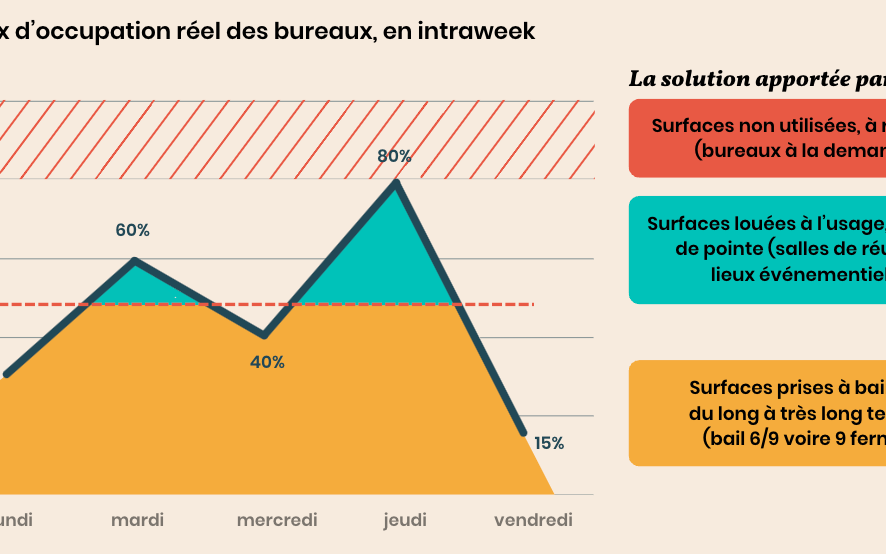
You have to go beyond this average occupancy rate of 45% and drill down to the level of the week to detect the so-called "intraweek" variations. Indeed, it is these that represent a major challenge for real estate portfolio managers.

When 50% of the space is occupied two days a week, the remaining 50% represents a huge cost for very little time of use. Incidentally, 43% of employees come to the office mainly to see their colleagues (Comet x YouGov 2023).
Yet halving the space would have harmful impacts: a degraded employee experience, a drop in attendance and an impact on company culture.
The intraweek variations, shaped like an "M" curve, illustrate the complexity of office use today, faced with an apparently simple alternative: keeping a second cost item on your income statement that is structurally under-efficient (the status quo), or significantly reducing that space and therefore the associated cost, thereby deciding to no longer welcome your teams when they want to get together but to force them to fit into a capacity that is now constrained. Yet a third way is taking shape.
Rather than drastically reducing space, companies can rethink the layout and use of their spaces to make them more flexible, more adaptable to the fluctuating needs of employees. By seeking to break out of the Manichean alternative between the rigidity of leases and the flexibility of on-demand office and meeting room solutions. By combining them to get the best of both worlds.
ONE SOLUTION: THE “HOTEL-OFFICE”
Faced with this dilemma between rigidity and significant costs, the “hotel-office” seems to be emerging as a hybrid solution combining long leases and flexible rentals.
42% of companies now want flexible leases where they only pay for the space actually used (CBRE 2023). This demand is explained by the low weekly use of traditional offices.
The central vision behind this “hotel-office” concept comes back to the very essence of what flexibility is for: it is designed to support needs that are not permanent, uncertain, short-term or without real visibility. Which is not the case for 100% of the office space a player needs, whatever its industry or its size.
The “hotel-office” combines spaces rented on a lasting basis in the form of long-term leases with a flexible offer on the same site. By keeping 50% of their space on a conventional lease, companies secure the stability of their future needs. The predictable ones, with a very high level of certainty, and which can therefore allow a long to very long lease to be signed. The remaining 50% of consumption being structurally marked by strong uncertainty in the predictability of the need and/or a limited number of occurrences of their occupation. These spaces are flexible and modular (on-demand offices/coworking rented for a few months or a year, on-demand meeting rooms for a few hours or a day, etc.), depending on one-off needs, and with the intensity of service required on a case-by-case basis (turnkey offer, event catering, tech support, concierge service, etc).

Example of a “hotel-office” building:
- Floors 9 & 10: short-term rental (12-24 months) in coworking
- Floors 6 to 8: flexible rentals of meeting/event rooms
- Floors 1 to 5: permanent base on long conventional leases (6-9 years)
By adopting this model, companies optimise their spaces, cut unnecessary costs and adapt to weekly variations, all while preserving the employee experience and company culture.
WHAT BENEFITS, AND FOR WHOM?
On the employee side, the gain is experiential. To start with, goodbye impersonal offices! The “hotel-office”, a real living space, offers its warm hospitality and its areas dedicated to collaboration and socialising. Above all, no more tense days when nobody has a seat. Flexible spaces, consumed and paid for on demand only, adapt day after day.
On the company side, the gain is organisational and financial: easy adjustment of space according to growth (from year to year) or the needs of the day (adapting and paying for spaces depending on attendance), without having to worry about spatial constraints. Nearly half of the real estate cost item in the income statement becomes flexible (no consumption = no cost), for an overall cost identical to the traditional model, or even a straight saving for the user. Flexibility and a tenfold employee experience, without paying any more for it: the best of both worlds.
On the investor side, the “hotel-office” makes it possible to generate a solid EBITDAR thanks to diversified financial flows: long leases, flexible rentals that generate more margin, and the securing of users who have signed their leases through an unheard-of flexible and serviced offer.
A WINNING BUSINESS MODEL
Financially, the “hotel-office” relies on flexibility and economies of scale. Space on long leases makes it possible to secure longer lease terms and Prime rents, since it benefits from the premium services of the whole building. Conversely, space operated as on-demand offices and meeting rooms can represent, for an operator that knows how to operate efficiently, an ability to pay a rent greatly increased by the generation of EBITDA.
A key advantage for the user, finally: a single place where all their needs are met, or even a single contract bringing together their conventional lease and a portfolio of flexible spaces (coworking, meeting rooms...) All of it operated by a single player, the counterparty of the user company.
The office is now no longer simply a place of work, but the nerve centre of the company, a place of collaboration and socialising. The office is now also far more than a cost item, but a product that is paid for according to use. Just like the automobile, which had its revolution more than twenty years ago already. It is a product that adapts to the needs of its consumers, who are now, incidentally, two in number: the user company and its employees. By rethinking uses and adopting serviced and flexible solutions, the “hotel-office” makes it possible to sustainably restore the value of office real estate, helping to pull it out of the crisis of uses and valuations it has been in since the Covid19 pandemic.
Bringing flexibility to bricks and mortar is no longer an option for the players who own it, but a necessity, at the risk of watching this shift in office uses pass them by (as Nokia watched digital photography supplant film photography, without seizing it). Redrawing the sharing of value and the ties -necessarily even stronger tomorrow- between owner and operator.
Because who wants to watch this paradigm shift go by without playing a central role in it?