A meeting has to be well organised to save your teams time and to support the development of your company.
The meeting is an important subject for companies because, on top of making it possible to move forward on substantive topics, it has an impact on employees' working time. That is why it must be managed as well as possible.
Employees reportedly spend an average of 8 hours a week in meetings*. Take a classic one-hour meeting, with 8 people around the table: that represents 8 hours of productive work, i.e. the equivalent of one employee's working day. But deep down, does this meeting really need to take place?
Before sending out the invitations, make sure you know its reason for being, and check that you cannot settle the subject with a simple discussion squeezed in between two other items.
The meeting is important for bringing together your colleagues who share common objectives such as:
- talking through new projects
- validating an important decision, passing on information
- obtaining information that is important for the development of the company
- analysing and finding solutions
- … etc
This meeting must nevertheless not become a routine, it has to be organised with a precise goal. You need to ask yourself the right questions beforehand.
How many people should you invite to your meeting?
In most cases, it is advisable not to bring together too many people, so as to gain in efficiency. Depending on the type of meeting, the number of participants can vary.
Which format for my meeting?
There exist no two identical meetings or seminars. Generating ideas, organising, negotiating… Every meeting must be given a precise objective and therefore a suitable working framework. Ask yourself what your objective is.
Making a call? Schedule a decision committee.
Informing? Choose the conference format.
Brainstorming? Go for a creativity workshop.
Before organising a meeting, always think about the result(s) you want to achieve!
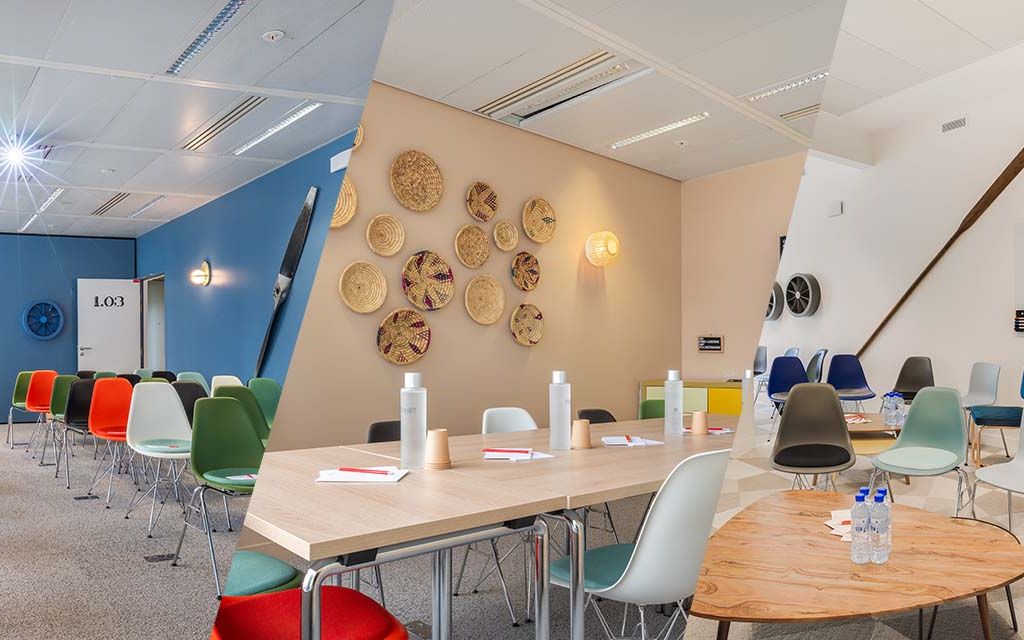
For what reason(s) should you get together?
- The information meeting:
- Probably the most widely used scenario for getting a message across to everyone concerned. The ideal is to opt for a conference configuration for this type of meeting
- The discussion meeting:
- Taking stock with your colleagues on the projects under way and the new objectives. Recommended configurations: Cabaret for a working session or Casual for a creativity workshop
- The training meeting:
- Training your (new) colleagues in new techniques or new products, by defining the key ideas to be shared and the skills to be acquired. For that, we advise you to set your room up in a U shape
With us you can organise your made-to-measure meetings! Fancy it? Head over to Cosmos 🚀
* according to a Barco and Circle Research study