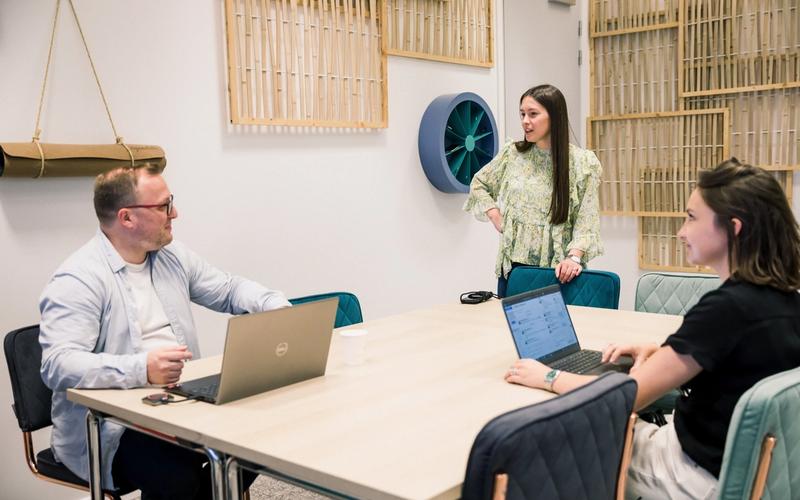

Here are 60 tips to make a success of your meetings, which turn out to be too frequent, badly prepared and held in less than suitable conditions.
The cométhode, why?
We are convinced that there is a science of the successful meeting.A way to make a meeting truly productive, creative and enjoyable. A set of rules and tips that multiply tenfold the value of this collective investment, to produce together, without destroying individual energies...
We wanted to shift the lines, to offer an alternative to the status quo! We explored the meeting in 360 degrees, to identify the best practices in the field. “Best practices” drawn from our own backgrounds as former bankers and consultants (which made us love to hate meetings). Practices inspired by the highest-performing companies (Google, Facebook, LVMH, McKinsey,...) always ahead of the game on meeting productivity methods. Tips from successful entrepreneurs, who inspire us every day. And finally, cognitive and behavioural sciences, which shed light on the way we think.
The environment is one of the essential components of a successful meeting. It is with this in mind that we founded, in 2016, CometMeetings. Inspiring meeting and seminar venues, which offer an ecosystem of services stimulating the creativity, the productivity and the well-being of every participant.
To make these good practices accessible to as many people as possible, we have gathered them here, in this Cométhode - the method of the collaborative, or how to succeed together. Tips to follow beforehand(to prepare your meetings as well as possible), to apply on D-day (to get the most out of them), and to make real afterwards (so that they really lead to something).
Here are the first 5 tips that are going to save your meetings...
1) Stop! Do you really have to meet?
Employees spend 8 hours a week in meetings*. Take a classic one-hour meeting, with 8 people around the table: that represents 8 hours of productive work, i.e. the equivalent of one employee's working day.
But deep down, does this meeting really have to take place? Before firing off the invites, make sure you know its raison d'être (and check that you cannot settle the matter with a simple chat between two other things).
* according to a study by Barco and Circle Research
2) Watch out for the "recurring meeting" option
Elon Musk (Tesla, SolarCity, SpaceX...) urges us to get rid of overly frequent meetings, “unless you have a critical emergency to handle”. As soon as the emergency is settled, the frequency of the meetings should drop. Too many meetings kill the meeting! Limit the number of times you get together, and you will maximise the value and the usefulness of each one.
3) The right format
There are no two identical meetings (if there are, it means you have already not applied our tip no. 2, well done). Generating ideas, organising, negotiating... Every meeting must be given a precise objective and therefore a suitable working framework.
Ask yourself what your objective is. Making a call? Schedule a decision committee.Informing? Choose the conference format. Brainstorming? Go for a creativity workshop. Before organising a meeting, always think about the result you want to achieve!
4) Invitation = information
The first reason? No agenda and no objectives set. As a result, you do not know why you have to meet, nor what is expected of you. Mercedes Erra (BETC) is quite capable of cancelling a meeting at the last minute if it has not been sufficiently prepared. Guillaume Pepy (SNCF), for his part, has already walked out of a meeting after 2 minutes because he found the objectives too vague. Ouch.
When you send the invitation, share the agenda and the documents useful for the meeting (at least 48h in advance, be nice). The objective will be clear and the thinking can even start in people's minds...
*according to a study by Wolf Management Consultants
5) Thanks God It’s Tuesday
Still half asleep, or already daydreaming about your weekend... The day of the week has an impact on the state of mind and the level of involvement of the participants.
The ideal day to meet? It would be Tuesday.* As for the meetings organised early on Monday and late on Friday, they would be the least dynamic ones. Obviously, this has to be nuanced: every day of the week brings a different atmosphere, so bear that in mind in the event of a highly strategic meeting.
*according to an Accountemps study